Showing posts with label subprime. Show all posts

Saturday, August 2, 2008

"What about the black community, Obama?" Uhuru Movement challenges Obama on unwillingness to speak to African community interests

from UhuruNews.com

ST. PETERSBURG, FL — On Friday, August 1, the Barack Obama presidential campaign hit a serious bump in a St. Petersburg, Florida town hall meeting as members of the International People’s Democratic Uhuru Movement (InPDUM) challenged Obama on his unwillingness to speak to the interests of the African community.


While demonstrators outside chanted “Obama, McCain, its the same game,” InPDUM members inside raised a banner that read “What about the black community, Obama?”

InPDUM International Organizer Diop Olugbala challenged Obama asking, “In the face of the numerous attacks that are made against the African community or the black community by the same U.S. government that you aspire to lead — and we are talking about attacks like the subprime mortgage that you spoke of that wasn't just a general ambiguous kind of phenomena, but a phenomena that targeted the African community and Latino community; attacks like the killing of Sean Bell by the New York police department and Javon Dawson right here in St. Petersburg by the St. Petersburg police, and Jena 6 and Hurricane Katrina, and the list goes on. In the face of all these attacks that are clearly being made on the African community, why is it that you have not had the ability to not one time speak to the interests and even speak on the behalf of the oppressed and exploited African community or black community in this country?”

After stammering, Obama made the claim that he had addressed all of those issues with public statements, but that he just may not have spoken out in the way desired.

It is well known that he did make a statement after the acquittals of the police who pumped 50 bullets into Sean Bell’s car on his wedding day stating that the unjust verdict needed to be respected.

On the U.S. government’s leaving African people for days to die after Hurricane Katrina he stated on September 6, 2005, “I do not subscribe to the notion that the painfully slow response of FEMA and the Department of Homeland Security was racially-based. The ineptitude was colorblind.”

Obama was right that he had not spoken to these issues as would be desired. While he may have conceded that the subprime loans were predatory, he has failed to condemn Penny Pritzker, his national finance advisor, for having made a fortune through the subprime mortgage scheme at the expense of Africans and Latinos.

In fact, Obama’s painting the U.S. as some place on the verge of a “post-racial” society with “race problems” being “90 percent” solved, his opposition to reparations for African people and his liquidating the colonial relationship that African people in the U.S. are held in are disarming. His role as a pied piper — leading African people who are disenchanted with the inability of the U.S. electoral process to provide any solution for them right back to the Democratic Party — is problematic for African people.

His role is one that works against African people’s struggle for self-determination — the loss of which was necessary for the building and maintaining of the United States of America.

The question for African people cannot be confined to whom to vote for in a bourgeois election where freedom and self-determination for African people will never be on the ballot. The question instead must be one of what must be done to win self-determination.

Tuesday, April 22, 2008

World Food Crisis and Starvation: Made in America

In America—especially in white America—we take food abundance for granted. From sushi to steak to salad and smoothies, countless food choices are part of our daily routine and a key component of our leisure and fun. One hundred and thirty-four million of us—75 percent of the adult U.S. population—are obese or overweight. (http://win.niddk.nih.gov/statistics/index.htm#preval)

Even the choice to be slim and fit based on a healthy diet is an option not available to most of humanity. For the majority of us hunger is no more than a momentary pang endured until the next refrigerator, restaurant, deli or grocery presents itself.

For 3 billion people around the world who are facing starvation, the chance for something edible has little to do with nutrition or leisure or fun. Anything to eat is a fleeting panacea for the pain of a chronically empty stomach, a pain that has been compared to battery acid in the abdomen. Thirty people a minute are dying of starvation (http://www.starvation.net/) in a world where half the world’s population lives on less than $2 a day.

In the news these days are reports of massive food rebellions in more than 30 countries in Africa, Asia and Latin America. In Haiti 80 percent of the population no longer have the resources to eat food. Millions in Haiti are forced to subsist on mud mixed with sugar and shortening. YouTube videos show UN and government police forces firing on crowds of angry people in Haiti, Egypt, Mexico and El Salvador.


For most of us in North America such realities may seem sad but very far removed for our lives. Ultimately, we believe, world starvation has nothing to do with us.

Living in a country built on the enslavement of African people, the genocide against the Indigenous people, and the spoils of colonial domination the world over, global hunger has, however, everything to do with us.

The reality is that every aspect of this world food crisis is made in white America, by Americans, for America’s economic benefit. Today’s skyrocketing rice and grain prices are not the result of shortages! We are seeing record rice crops globally this year! As an Asia Times article, “Rice, death and the dollar” states, “The global food crisis is a monetary phenomenon, a … consequence of America’s attempt to inflate its way out of a market failure…” (http://www.atimes.com/atimes/Global_Economy/JD22Dj01.html)

Here are some of the real factors contributing to the current rapid rise in food costs and starvation worldwide.

Wall Street speculation. With the dollar tanking and banks and corporations going bankrupt (and being bailed out by the government and the Fed), commodities, such as grains and agriculture are the hottest Wall Street investment sector today! For investors they are a “safe haven” against “the falling dollar and the loss of faith in stock markets.” (Energyandcapital.com)

As a last ditch effort to save the U.S. economy with the bursting of the housing bubble, investors are now creating a grains bubble, driving prices off the charts, regardless of the cost of suffering for the majority of the world.

Average prices for rice have reached a 20-year high this month, with Thai rice going up from $360 a ton in December 2007 to $850 this week. Investors are working overtime trying to get a piece of these profits, while those living on a dollar or two a day can’t afford even a plate of rice.

Billionaire Jim Rogers is on TV constantly advising people to “buy agriculture!” Tellingly the blog Energy and Capital describes the brutal conditions of starvation for most of the world’s impoverished people, talks about the grain price hikes, says there is “no relief in sight,” and then ends with the statement: “…enough of the doom and gloom. How can I profit from this? Well, I'm gonna tell you…” (http://www.energyandcapital.com/articles/grain-food+prices-commodities/663)

You can be sure that now all the bad subprime mortgage bonds in your money market or retirement funds have been replaced with commodities investments. How many children must die for our baby boomers to enjoy a “secure” retirement?

Biofuels are genocide. Wall Street investors are creating an ethanol bubble too, driving up the prices of grain grown for fuel rather than for food. Farmers around the world can no longer afford to grow grain for food when the earnings for fuel are far greater!

Former Cuban president Fidel Castro has been campaigning for the past couple of years against biofuels. He has called ethanol “genocide,” saying that biofuels will “cost the lives of 3 billion people.”

Castro’s article, “The Internationalization of Genocide,” states, “The five top producers of the corn, barley, sorghum, rye, millet and oats that Bush wants to turn into raw materials for producing ethanol supply 679 million tons of the world market…In turn, the five top consumers, some of which are also producers of these grains, currently need 604 million tons annually. The available surplus comes down to less than 80 million tons.”

Castro adds, “This colossal waste of cereals for producing fuel…would serve only to save the rich countries less than 15 percent of what is annually consumed by their voracious automobiles.” (http://mrzine.monthlyreview.org/castro050407.html)

Forced deregulation of world agricultural markets. Historically countries around the world produced food for themselves and their governments kept restrictions on the price of food to prevent speculation and price gouging. Haiti, where the people are today forced to subsist on a steady diet of mud, is a perfect example. Twenty-five years ago Haitian farmers grew and exported their own rice.

But in the late 1980s the U.S. backed IMF forced Haiti, as a condition for a desperately needed loan, to deregulate their markets and open them up to competition from the outside. The U.S. then dumped its government-subsidized rice onto Haiti (and many other countries around the world), selling the American rice cheaper than Haiti farmers could sell theirs for. The U.S. rice dumping brought to an abrupt halt Haiti’s own self-sufficient agricultural infrastructure and forced millions of people into desperate poverty.

U.S. Agribusiness. According to Gretchen Gordon in, “The Food Crisis: Global Markets and Deregulation Strike Again,” three major corporations, Cargill, Archer Daniels Midland and Bunge, “control the vast majority of global grain trading, while Monsanto controls more than one-fifth of the global market in seeds.”

While billions of human beings are starving, Cargill’s third quarter 2007 profits increased more than 86 percent and Monsanto’s were up 45 percent. In fact they are using the current crisis to further impose their genetically modified seeds on the peoples of the world.

The U.S. will not be immune from this crisis. Almost 22 percent of African families in the U.S. experience food insecurity—not knowing where their next meal will come from. One out of twelve Indigenous families forced onto reservations on their own land experience food insecurity with hunger. (http://www.wole.org/hunger.htm)

Throughout the U.S. the African community has been hit hard by the collapse of the subprime mortgage scam, which again made Wall Street bankers and investors billions of dollars. Cities with high African populations, such as Cleveland, Baltimore, Detroit and Atlanta are seeing tens of thousands of families facing foreclosure and homelessness as a result of this. When the full weight of this crisis hits over the next couple of years millions of African people in America will be plunged even more deeply into poverty.

What can we do?

The United Nations, the U.S. government and the websites of countless organizations are calling for donations of money for food for some of these countries. Charity, however, will never solve this problem, any more than Bush’s little tax refund will prevent the downturn of the U.S. economy.

The only thing that will really change this crisis is the end of a system that acts as a parasite sucking the blood of the peoples of the world. Let’s face it: the prosperity of the white world is directly dependent on slavery, genocide and theft of the resources of just about everyone else. For us to live, they can’t! World peace and cooperation is, of course, forever impossible under such a system.

Going “green” in and of itself is no solution! Environmentalism inside of a system sitting on a pedestal of slavery and colonialism will do nothing but make us feel good for recycling bottles or saving the ozone, while the majority of people continue to suffer and die. Environmental destruction is simply a byproduct of a system that wipes out whole peoples and civilizations to maintain our life style!

What will end hunger and starvation is when the earth’s oppressed peoples finally have control over their land, resources, lives and destinies again. The people of Iraq, Palestine, Venezuela, along with African, Mexican and Indigenous people colonized inside this country are struggling for this. This is the struggle for national liberation.

The Uhuru Movement has built the African Socialist International (ASI), made up of African individuals and organizations in Africa, the U.S., the Caribbean, South America, Europe—wherever African people have been dispersed around the world.

The ASI is based on the premise that Africans are one people everywhere and that the food, diamonds, oil, coltan, bauxite, uranium and all the resources of Africa are the birthright of African people the world over, not corporations and Western imperial nations.

The Uhuru Movement, led by the African People’s Socialist Party has built the International People’s Democratic Uhuru Movement (InPDUM) in the U.S. and Africa. InPDUM is a people’s organization that defends the democratic rights of the African community that has been massively imprisoned, placed under martial law and subjected to oppressive educational systems worldwide.

Other dynamic fronts of the Uhuru Movement include the All African People’s Development and Empowerment Program (AAPDEP), organizing African scientists, engineers and health care workers from the U.S. to participate in sustainable electrification, rain water harvesting and heath care projects in West Africa.

There is the African Internationalist Student Organization (AISO) for African students from middle school through graduate school. Uhuru News features the on-line radio station Uhuru Radio, Burning Spear Records and The Burning Spear newspaper. Another front, the African People’s Solidarity Committee (APSC), is an organization of white people working in white communities under the leadership of the Uhuru Movement

White people who find that living at the expense of the suffering of the vast majority of humanity is intolerable can join the Uhuru Solidarity Movement led by APSC. You and I can make a difference, not as mere consumers of information, but by taking a real stand in solidarity for the future of the planet in the hands of African and oppressed people. (http://www.uhurunews.com/)

A stand in solidarity with African and oppressed people everywhere allows us to be part of a great movement to end the system of starvation, of slaves and slave masters and participate in building a system of justice and peace. As the source of most of the problems in today’s world, imperialism must go. In its place must be a system built on justice, equity and human needs, not profit, greed and exploitation. This is the vision of the movement for African liberation.

Let’s get to work. There is so much to do.

Saturday, December 15, 2007

Subprime on Backs of Africans

Africans bear brunt of subprime crisis in U.S. economy built on slavery and genocide

The subprime mortgage mess is making headlines, but what the media barely mentions is that the African community is bearing the brunt of it.

Once again, bankers, brokers, lenders and even regular white working America have profited mightily and are bailed out by the government when their strategy fails. The African community is used, bled dry, and then criminalized and blamed for the problem.

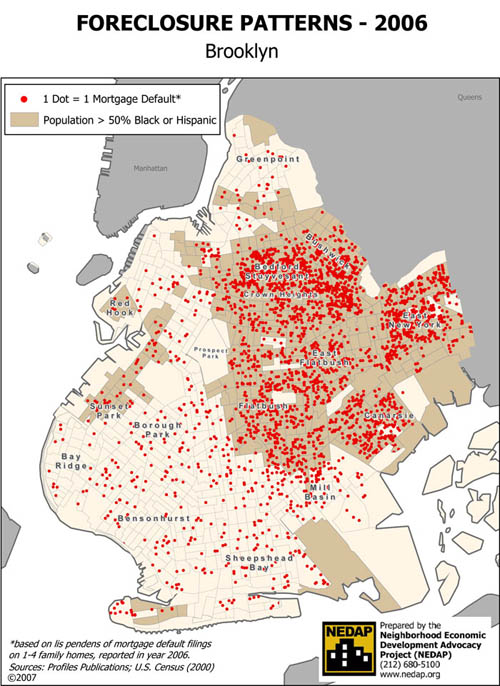
You have to dig to find out that, for instance, more African borrowers making upwards of $100,000 a year were given subprime mortgages than were whites making under $40,000. African communities were targeted for subprime and adjustable rate mortgages as a very lucrative new market for loan sharks.

Cities with large African populations tell the story: Atlanta (map), Cleveland (map), Detroit, Brooklyn (map), to name a few.

Early in this decade the government and the Fed began lowering interest rates. Housing prices skyrocketed and millions of Americans began tapping into their home equity, fueling a “wealth effect,” and massive spending.

The lower rates sparked the speculative housing market and gentrification, as lower income white people could suddenly become homeowners by buying in an African community. Or they could become entrepreneurs by buying up “ugly houses” to flip.

TV channels were spawned by gentrification and a whole economy centered on Lowe’s, Home Depot, Restoration Hardware, Starbucks, art galleries and cute restaurants. Houses of Africans, including the elderly, were taken from under them as white people demanded that code violations be enforced for their benefit.

As housing prices in African neighborhoods skyrocketed, the culture of the community was criminalized and police presence intensified to protect the white “pioneers” from the surrounding impoverished population. African people were dispersed further and further into decaying suburbs, crunched in with other family members or sent to government-sponsored prison housing.

None of this is new, however. It’s the same story that has played out for more than half a millennium.

Since African human beings were first abducted at gunpoint from Africa, turned into a commodity and transported to America as well-insured cargo, stacked on pallets in the holds of ships, the Western world has gotten its economic stimulus from the oppression of others.

More than anything, America sits on the backs of Africans.

Today we talk about oil prices and fluctuations in the stock market, but there were whole centuries when the price of an African was the most important topic at businessmen’s lunches in New York and London. The Wall Street stock exchange sits on the site of New York auction blocks and slave ship docks.

The African cemetery found under a high rise building on Wall Street is the perfect metaphor for this country: America’s wealth resting literally on the bodies of African people.

As Omali Yeshitela proves in his books Omali Yeshitela Speaks and One Africa! One Nation!, Europe was a cold, barren, impoverished and war-like place in the Middle Ages. It was characterized by oppression, plague and feudal serfdom when it set out to rescue itself by ravaging Africa.

Henry the Navigator of Portugal sent ships out to the coast of West Africa around 1420, and by the year 1500 Europe had already extracted 81,000 African people and 700 tons of gold from Africa.

Around the same time Columbus began the process of massive genocide of the Indigenous people of the Americas and the theft of their land and resources.

We are taught ridiculous myths that somehow Europe worked hard, saved its money and thus became the dominant economic and military power in the world. But an honest look at history shows that the development of wealth and power in Europe parallels its assault on Africa and other peoples every step of the way.

In the 1500s the Spanish government monopolized the trade in African human beings, even as the governments of Holland, England and France were waiting in the wings. They would all go to war for a piece of this most valuable commodity, just as oil wars are being fought today.

Independent businessmen also wanted some of this loot, financing their own ships as pirates or “privateers” under the banner of “free trade.” Entrepreneurs like Jean Lafitte raided the state-owned slave ships laden with human cargo and made a fortune selling Africans off the coast of New Orleans at discount rates.

As Yeshitela, again points out, the trade in African people did far more than make southern plantation owners wealthy. The plantations are long gone but the wealth of African enslavement has been compounded in the overall economy of America a million times over.

What part of Europe’s and America’s economy did not get started on the human trade? Banking, insurance, ship building, industry, universities, tourism, railroads, housing, hotels, law firms, the garment industry, retail sales, Wall Street itself were all spawned by African enslavement.

We’re taught that Africans became “free” after the official enslavement ended in 1865 in the U.S. In reality other forms of African exploitation were found to be more lucrative for the Western economy.

In Africa Europe imposed direct colonialism. There was no word for “genocide” when Europe and America were slaughtering millions of African people on the continent as they ripped out diamonds, rubber, ivory, gold, and other precious resources that further consolidated Western wealth and power.

Rarely discussed, but extremely important to America’s wealth, is the system of convict leasing. For more than 70 years thousands of African people were rounded up under Jim Crow laws, kept in work camps and leased out by state governments to plantations, limestone and phosphorus mines, road gangs and logging teams.

The brutal system of convict leasing rebuilt the economy of the southern states following the Civil War. In the late 19th century more than 80 percent of the revenue of Alabama came from convict leasing. I have read that Hitler modeled work camps on the convict leasing system, which was known to be worse than slavery. The white people’s motto was, “One dies, get another.”

European immigrants coming to America were pretty clear that American “opportunities” came to them because of African enslavement and the genocide against the Indigenous people.

Throughout most of the 19th century street gangs made up of white workers in northern cities functioned as a terrorist force against African people who had escaped to the north.

Lynching was the popular pastime of white America for a hundred years. These chilling festivals of violence had the avid participation of the whole white family. Children were dressed up and posed for photographs in front of the lifeless bodies of African people. This public torture and murder of African people was accompanied by music, dancing and food vendors.

White people terrorized Africans who were prospering in independent economic communities. Tulsa, Oklahoma and Rosewood, Florida are only the most famous examples of this. All over the country Africans banded together, buying land and setting up collective economic ventures that were quite successful, but these were destroyed one after another. White people would never allow Africans to become more prosperous than they.

Similarly, the media tell us the reason Africa is poor today is because its leaders are “corrupt.” But every time an African leader rises up, demanding that the resources of his country benefit the people, the leader has been assassinated or overthrown by America or Europe—from Patrice Lumumba to Kwame Nkrumah to Thomas Sankara.

It’s not corruption; it’s the U.S. policy of neocolonialism, which ensures that Africa’s resources stay in the pocket of Western powers. I have read that more than 80 percent of all the mineral resources the U.S. needs to function are in Africa. This is the basis for the U.S. militarization of Africa under AFRICOM.

In this country, after the leaders of the Black Power Movement of the 1960s were assassinated or imprisoned by the government, the U.S. began flooding African communities with drugs: heroin and later crack cocaine. This is well-documented from many sources.

We cannot underestimate the importance of this illegal drug trade to the U.S. economy. Said by the United Nations to be worth more than $500 billion a year, illegal drugs constitute the third largest commodity in the world, behind oil and arms.

Clearly those billions of narco-dollars are not floating around in African communities, but rather buy the cars, mansions and private jets of the Wall Street elite. They also benefit white society as a whole. Since the late 70s drug money has funded real estate, car dealerships, jewelry stores, restaurants and more.

Meanwhile, the African community is left with a government-imposed, penny-ante illegal drug economy that primarily serves to criminalize the entire African population. The imposed drug economy feeds the prison industry, another booming component of the U.S. economy.

More than half of the 2.3 million prisoners in the U.S. today are African, the cornerstone of a $50 billion industry. Called the new gold rush, the prison industry has spawned countless spin-off businesses, including phone companies, clothing, construction, vending machines, instruments of suppression and more.

Most prisons are filled with urban Africans but located in rural white America, where prisons are the third largest industry, behind gambling and pig farming. Many states have a conscious strategy to use prisons as economic stimulus for rural counties, providing white high school graduates high paying jobs as guards.

Some people are predicting that the subprime collapse along with the low dollar and high oil prices could bring about the demise of the U.S. economy.

If so, it’s just the logical conclusion of an obese, parasitic economic system that has been sitting on a shaky foundation of enslavement and genocide for more than 500 years.

Penny Hess is author of Overturning the Culture of Violence and the chair of the African People’s Solidarity Committee which is led by the African People’s Socialist Party. Her analysis is based on the understandings of Omali Yeshitela. She can be reached at info@apscuhuru.org.