Showing posts with label gentrification. Show all posts

Wednesday, July 2, 2008

Omali Yeshitela: "I ain't speaking to City Hall or the police department."

(reposted from Creative Loafing)

By Alex Pickett, Published 07.02.08

Who? Omali Yeshitela, founder of the International People's Democratic Uhuru Movement

Sphere of influence: Since Yeshitela (formerly Joe Waller) tore down a racist mural in St. Petersburg's City Hall, he has earned the respect (and ire) of St. Petersburg residents both black and white. Though once praised by high-profile politicians, he has distanced himself from City Hall and prominent African-American organizations in recent years. He continues to remain active in promoting African self-determination in other U.S. cities and Africa.

How he makes a difference: Some historians credit Yeshitela for ushering in the civil-rights movement in St. Pete, and even some white politicians admit he has empowered the city's black community. Through the Uhuru Movement, he has helped create retail stores, a gym, sports leagues and a radio station. Whenever there is an issue involving African-Americans and police, he becomes involved; a day after the shooting death of Javon Dawson by a St. Petersburg police officer earlier this month, he called a press conference condemning the shooting and telling witnesses that they could talk to a lawyer representing Dawson's mother.

CL: Describe to me what led you to tearing down the City Hall painting in the 1960s. Was it a turning point for you?

Yeshitela: I don't think tearing the mural down was a turning point for me. I had already come to a turning point. That's why I was down there. I was with the Student Nonviolent Coordinating Committee (SNCC). I had made a clear choice that was the organization I would be associated with because of its black power demand, and because of its boldness and willingness to take on struggle where traditional civil rights organizations seemed unable to go.

We had been involved in letter-writing campaigns to the mayor about that mural, because the mural was horrible. It was an 8-by-4-foot display in the center of city power. It represented to us a relationship. It was like locking this relationship that they perceived as one between the African and white community that should exist forever. It was a caricature of black people. It wasn't a caricature of all the people; it was black people that were caricatured on there.

So after a series of letter writings and a number of marches down to City Hall, on one occasion, I walked into City Hall with five other Africans and tore it from the wall. I'll never forget this nice woman who was standing upstairs and she says, "You black bastard!" And we walked out with the painting.

This was where the whole concept of black power was still exciting to a lot of people around the world and police were unaccustomed to dealing with forces like us. So we started marching down the street carrying the mural. We made it to Central [Avenue] -- I don't remember how far on Central -- and this cop grabbed me. I'll never forget he was trembling. He grabbed me, and he was literally trembling. Others pulled me away and I ended up running down the street, dragging the mural behind me. I got to the back parking lot of Webb City and was stopped and arrested and went to jail.

It was an uproar. It was media from everywhere. They held some of the longest court hearings that went on late into the night. They were historic in terms of their duration into the night. I was charged with I think 11 offenses: disturbing the peace, inciting a riot, resisting arrest with violence, resisting arrest without violence, destruction of public property, just a whole array of charges were thrown at me. I think I was tried for disturbing the peace and probably destruction of public property and sentenced on one of those to six months. I spent a lot of time in the city jail first. They used to keep me isolated, because if I was with other black prisoners it created a problem for them. So they put me in this basement that they had in the city jail and on occasion they would bring little white students through on tours through the jail. And they would bring them down to the hole to see me.

It was an alarming thing for the city officials, and for the state as well, because what happened is it mobilized citizens throughout the state of Florida. Because it was kind of direct action that was talked about a lot philosophically at that time in the civil rights movement.

What was the turning point for you?

I used to -- before there were sit ins and things like this, before Rosa Parks, when there was the little yellow line in the back of the city buses here -- I refused to go behind the yellow line when my mother wasn't with me, to her dismay. I'm the guy who would go to Webb City and would refuse to drink out of the colored water fountains and would go on the fourth floor, where they had the snack bar. Africans on the first floor could eat as long as we were standing, but we could not eat at the snack bar where they sit down. I would go and do it and sit down and they'd kick me out and what have you. Until my high school English teacher learned what I was doing and sort of intervened to stop me from doing that.

It seems like there's been a history of sorts. In fact, one of the reasons I left high school -- I quit high school in my senior year because I was in one of these special classes that's supposedly for bright people and I had this professor who was well recognized as being a top notch professor. He made the statement in class one day that Africans would have to earn the respect of white people and I had a serious disagreement. ... We had struggles around that.

My text for learning how to read was the St. Petersburg Times, and I could read while I was still in diapers. And the stories I grew up reading were of lynchings and other terrible things happening to African people. So it was something that I was always conscious of and to the dismay of my parents, never comfortable with, and always struggled against.

Since Mayor Baker began his Midtown initiatives, have things gotten better in Midtown?

Worse. In the sense that what Baker has done is he co-opted much of the apparent leadership in this community. I don't have to mention Darryl Rouson, but one figure that was of great significance to this community was Goliath Davis. Because he did a tremendous job of containing that terrible police organization temporarily and because of that created a lot of hostility in certain sectors of the white community and certain ideological components of that community. This was an aspect of the city that Baker needed to win as well. To pacify that community without alienating the African community, he kicked Goliath Davis upstairs. I say "kicked upstairs" but I think it was like an elevator because Goliath didn't seem to mind it too much, this concept of deputy mayor. Without a budget. We've seen this kind of thing happen and the conditions of the community continue to deteriorate.

The Hope Six thing that got rid of Jordan Park proper in the name of helping the people. Now only half the people that were there are now there. We can't even trace the others because it wasn't required for them to know what happened to other people. In this community, the white guys in pick-up trucks and clipboards coming through, this massive gentrification where so many people have lost their homes and been kicked out, all in the name of helping us.

And in helping us, the Sweetbay along with other things they have done to help us, raised the value of the property, hence the property taxes, makes it difficult for these old women who have been left now to pay the property taxes and some of that has resulted in loss of their homes. So it hasn't been better at all, it's been worse.

And now you have more return to the policing. What the guy whose there now -- Chuck Harmon -- he brought the [Pinellas County] Sheriff's Department back in. And the sheriff's department has a reputation for rabid anti-African sentiments in that department. They did terrible things in this community following the rebellions that happened here. The sheriff's department is notorious in their brutality. Where as Goliath had told them to keep out, Harmon brought them back in. So after eight years -- they had gone eight years without a single African being killed by a cop -- the first was killed by the sheriff's department, two were killed by the sheriff's department, and now this thing with Javon by the [St. Petersburg] Police Department.

The city reminds me of a heart patient. It has a heart attack, and promises the doctor "I'm going to change my ways, and I'm going to live differently now," and then forget and go back to the same things that started it. That's what this city reminds me of. So it's worse than it was before.

What's the answer to economic development in Midtown?

It is something the city cannot do, that is one thing I'm aware of. They cannot participate in it; it would go against interests of some very entrenched economic forces here. The significance of the African population here is that it is a tremendously important kind of labor reserve for us. And it's cheap labor. And at the point that this community can fend for itself then its labor becomes competitive in terms of what has to be paid for it, and it won't ever happen.

African people are going to have make revolution to be free. We are going to have to be a self-determining people, a people that do not have to rely on the goodwill of anybody else. There are no people on the planet Earth that has ever been able to change their circumstances because of somebody else's good will and that's never happened for us. The thing is that the more one learns about one's condition as an African, the more it becomes clear that the conditions I'm suffering from in St. Petersburg are not separate and distinct from the suffering in Haiti or in Jamaica or in Nigeria or in Sudan. The same historical process is responsible for it and part of it is an attack of Africa, dispersal of African people, a separation of African people from each other and from our resources. That is the resolution there is no other resolution.

Something that may have seemed far fetched just a little while ago, is becoming clearer every day to the point that even pundits tied to the ruling class are raising the question of whether the empire is in decline now. And, of course it is. It is in decline as part of a process that sees other peoples around the world whose resources were necessary for the wealth of the empire. And as people rise up everywhere, the empire is in a state of decline and African people will have to rise up and take back our resources before we'll be free. I don't expect, in the final analysis, any meaningful solutions within the context of the existing system. I'm capable of struggling for certain kinds of reform that contribute to positioning the population and enhancing its capacity to resist and transform our condition. But America can't solve our problems.

But on the same token, the Uhuru Movement seems to have lost influence over the last few years.

You talk about influence. I just read an editorial in the St. Petersburg Times that says nobody will talk to the police. Nobody in the African community. There were 200 and some odd people, they said, where they murdered Javon Dawson, but nobody would talk to the police because of Omali Yeshitela and the Uhuru movement. That's what they said. When this crisis happens you will see the person who heads up the Justice For Javon Dawson committee is his stepmother and his cousins and other folks who are members of this organization. We're not as influential as we'd like to be, and we don't have the numbers that we'd like to have.

Have you heard from any witnesses on what exactly happened?

We've heard people. We've also watched Channel 9. I want to mention this because they talk about Omali Yeshitela won't turn over witnesses, they should subpoena Channel 9. Because I saw people on Channel 9, young people, who are saying the boy didn't have a gun. Yes, I have heard people say that they were there and didn't have a gun. I heard one person go further stating that her daughter who was with him earlier on had actually patted him down and there was no weapon in his pockets.

And this whole thing about how we won't let anybody testify is just nonsense, and it's a way to change the subject, because the real deal is that you have a 17-year-old youngster with no criminal history. And the thing that's really interesting about this is every time the police kills somebody in this community, the next day the first thing you see in the newspaper is a mugshot, and the implication there is that the killing was justified because this person has a record. Now, the media that has so much respect for criminal records, in this instance when they can't find a mugshot, they don't say "There's something wrong here. This kid doesn't have a record. That he's never committed a crime in his life, but he decides on this night the first criminal act he's going to engage in is point a gun at the police, and after pointing the gun at police, they find a way to shoot him, though he's shooting at them, twice in the back." Not only is that strange, but the fact is that we've got a 24-year-old kid that's just back from Iraq, from another occupation, who kills him. That's not even a story. The story is the mysterious witnesses that Omali Yeshitela and the Uhuru movement won't produce. What about those witnesses that Channel 9 won't produce?

So they create this thing that somehow we're responsible for anybody talking to the police. They have a problem, and the problem is it doesn't make sense the boy was shot in the back, not in the side, in the back.

There's a lawyer now that's working with the family. Her name is Maura Kiefer, and she is trying to interview witnesses that people give to her so that she can have an approach of taking these witnesses, so these youngsters won't have to face the same cops they saw gun down this boy, their parents can be there and this is a condition that she is trying to establish with the state's attorney when she goes to them. We have nothing to do with keeping witnesses from testifying at all.

Would this be as big of an issue with you if this was an African-American cop that shot Javon Dawson?

It'd be more of an issue. His young brother had gone to try and help his brother, and I'm told it was a black cop that told him to "get back or you can get shot too" or something to that effect.

The state is the state, and you know people who work for that institution are just as capable. The police is a military organization. Its job is an occupation force in this community. Just like you got Iraqis who work with the U.S. to occupy their country, there are black people who do it here. Just like you had Indian scouts that helped the calvary to track down the indigenous peoples here and wiped them out, we got Africans that will do the same thing.

It would be just as serious for us, and in some ways it would be more serious if it were an African that did it.

But it is worth noting that in every instance these shootings have happened up until now, they've been white cops that have done it.

I think you had a cop that was afraid. He might have even flashed back to Iraq. You know, that's their job to subdue communities. You're in Fallujah again. You've got all these people who know nothing about, in a community about which you know nothing. Listen, when police were called they were called because of too many youngsters in the street and noise from a party. They weren't called to it because of a robbery, mugging, a rape or a killing; they were called because of too much noise at a party. You could send a social worker to take care of that. But they sent the Save Summer guys out there, and one of them knew what occupation really meant and killed that boy.

How come you and the Uhuru don't come out more strongly against black-on-black crime?

We do. We just don't call it black-on-black crime. Most of what you call black-on-black crime is white-on-black crime. It's a façade.

I mean, it's a thing we're concerned about. On a regular basis we challenge the community about violence, but we have a relationship with the people. We're not the police working against the people and preaching at the people; we work with the people to try to change from within. The solution is not the police and not the church. The solution is organizing people to change their circumstances, that's a long and difficult thing. But believe me when I tell you that we challenge this community in a serious way.

If you had the opportunity to move with me in this community, you would see the relationship that we have with young people and the respect that is there with young people. And the fact is if people thought we were in the vicinity where something illegal or violence against somebody else was about to happen, they would cease and desist. We have that kind of respect, because we struggle against it. But we don't call the newspaper. We don't work like that.

It's like Barack Obama suddenly discovering that fathers need to take care of their children. That was his Sister Souljah moment. That was his way to speak to the so-called white social conservatives. I ain't speaking to white social conservatives, I ain't speaking at city hall or the police department. My discussion happens in this community. ... Our attempt is not to have that discussion with white folk, it's to have that discussion inside our community.

We don't want violence in this community; in fact, we have campaigns and programs that say if a brother kills another, you are the police. You are working with the police, you are doing the very same thing they are doing. We have produced DVDs that are not only distributed here against that kind of stuff but all around the world, but we place the violence in the proper context. ... It's pandering. It's pandering to a racist, colonialist assumptions about this community. It's pandering, and it's contributing to this whole notion of the need to have this external force to control our community. it liquidates the contradictions inside this community caused by policies outside this community. so this whole discussion as it would happen on black-on-black crime places the onus of responsibility for the conditions of existence on its victims. So we won't participate with that. We won't participate with that.

Do you agree with the "no snitching" code?

I think it exists in the police department. In fact, they've done movies on it. they call it the code of silence. I haven't heard any report yet of cops saying what happened that night, just this one cop.

When you talk about a code of snitching ... I believe that what this country does is what they cursed the Nazis for doing. They would have an informant on every corner just snitching on people inside their community for the benefit of the state. If it's bad when Nazis do it, it's bad when African people do it. You can't have it both ways. You can't say it's bad to turn a community into a community of informers and snitches when it comes to white people, and it's good when it comes to African people, that somehow we're supposed to be the informers.

The bigger question is this: Why is it that the police department has so alienated the African community that you have to be worried about a code of snitching? That ain't our problem. That's something wrong in the relationship that exists between the police department and the African community. The question really needs to be asked -- why is it that there is such an animosity existing between the community and the police department that people seem to have a problem talking to them?

Do you worry that sometimes talk of socialism and revolution may turn off younger people from your ideas?

It doesn't worry me. the majority of people we come into contact with don't relate to us because of communism, socialism or capitalism. They relate to us because of the pain this system imposes on them. I think most people can relate to goodness, to try and make things better. So most people who we hear that discussion from, like some middle class folk. Ordinary people aren't debating that question. They're trying to feed their children and get them off to school safety and things like that. But I will tell you this -- what we are discovering is daily young people, I n particular, are demanding revolution. They don't want some milquetoast reformist agenda. Young people are demanding revolutionary transformation. Again, it's not just here. All over other world that's our experience. Because we've been reformed out. For example, how many civil rights bills do you think will ever happen. It's not going to happen anymore and what has been the consequence of the last one, except for the middle class? Nothing.

For an organization for African-American self-determination, there seems to be a lot of white people in your group. What's up with that?

Let me tell you this. [Laughs.] It's an interesting question. We're called black nationalists by some folk, and then they see the white people they say, "Well, there's so many white people that something's wrong with them." I have integrationists, who in an attempt to slander me, spread the word that I'm married to a white woman. And I have the same integrationists who say they hate me because I'm for black power and this and that.

When the Nicaraguan revolution took off, before they got to Managua in July of '79, I didn't even know a Nicaraguan. But I went to find some, so we could put all of our organization resources at their disposal, because we could support the struggle of the Nicaraguan people. We did not require that they abdicate their struggle for self-determination. We did not require that they develop a taste for Ray Charles or anything like that. We were in solidarity with that movement.

We have a movement that anybody who wants to express solidarity with can join, but it is a movement for self-determination. And white people can actually join a movement that supports self-determination for black people. There's really no mystery to it.

The problem that we have is this whole racially-based politic that makes the assumption, somehow, that if there are white people or black people who are working in the same process that somehow it must be some kind of integrationist process, or it must be some process that white people are leading. That's usually how the thought process works.

There are white people that have tremendous solidarity. There have been people who have been in the movement 30 years or more. White people in solidarity with the struggle of African people.

Beyond that, most of the resources of the peoples of the world are located in a white community somewhere and genuine solidarity by white folk is required for us to repossess some of our resources. Some of these are material resources and some are human resources. It's a legitimate thing for white people to work in solidarity with the struggle of African people.

How do you feel about Barack Obama?

He's a wonderful representative for white power. I think that his role in part is at a time of tremendous crisis for this whole system that Barack Obama is a neo-colonial ploy. He is a white power in black face. At a time when Africans would be looking for alternatives to the system, he's dragging Africans into the safe embrace of the Democratic Party and the system. He cleans up the image of America throughout the whole world. He becomes an apologist for white nationalism, I'm not just talking about America but white nationalism proper. He condemns anything that comes from this community. he talks about a post-racial America. He is an apologist for the relationship black people have to this country. It's an interesting situation because a lot of black people follow Obama because they think he stands for black power and a alit of white people follow him because they know he doesn't. I think it's a really interesting situation.

How did you come to meet [hip-hop group] Dead Prez?

They were in our organization. They were in Tallahassee. They joined our organization. One of them used to run our New York office.

Do you know if they are going to tour here any time soon?

I don't [laughs].


Friday, June 13, 2008

Not one more black life: Oakland vigilante defeated; Justice for Javon Dawson!

McCullough defeated!

Vigilante and attempted child murderer Patrick McCullough, running on an anti-black platform for the Oakland city council district 1 seat, was soundly defeated by incumbent Jane Brunner in the June 3 elections. After an Uhuru Movement-led campaign exposing him as a brutal and divisive front man for white property and corporate interests in North Oakland, McCullough's bid was routed when Brunner took 73 percent of the vote. See more on Patrick McCullough.

Of course Brunner won on a similar anti-African, more-police platform, but it was important to show that any candidate who carries out open violence against the black community (in this case an unarmed African 16-year-old) must pay a political price.

Justice for Javon Dawson!

At the St. Petersburg, FL headquarters of the African People's Socialist Party, the African community is rallying around the campaign for justice for Javon Dawson, a 17-year-old gunned down by police officer Terrance Nemeth last week who shot the young man in the back last Saturday night during a high school graduation party.

As always the media are working overtime in an attempt to defend the police and criminalize the victim. Since young Dawson had no police record, the police are saying he had a gun, something that all witnesses deny. Nemeth was an Iraq war veteran, known as a sharpshooter. Chairman Omali Yeshitela noted that Nemeth was acting as if he were in Fallujah, comparing police containment policies in U. S. African communities to the U.S. occupying army in Iraq.

The Uhuru Movement is linking this latest police murder of a young black man with the city of St. Petersburg's plans for a new multi-million dollar waterfront stadium deal that is part of the scheme to transform St. Pete from a middle class tourist center to an upper-class Palm Beach-style tourist mecca.

Generally when the city or white people plan to gentrify and make money it is at the expense of the African community. The existing sports arena, Tropicana Field, was built in the 1990s by destroying a thriving black neighborhood and business center known as the Gas Plant. Although jobs were promised to the African community, none have ever materialized.

Tropicana field sits on the edge of the historic south side African community here. The plan for the new stadium, to be built on the waterfront about 12 blocks away from Tropicana, is headed up by Devil Rays owner and Wall Street investment banker Stuart Sternberg with the complicity of Mayor Baker and his cohorts. Baker won his election on the promise of economic development for the African community, something that has only benefitted an elite few in the black community. Baker renamed the historically African area "Midtown," and opened the flood gates for white gentrification.

Although relying on a shaky proposal for raising the $500 million for the new waterfront stadium in a town hard hit by the housing market crash, the investors and others plan to make a lot of money on this.

Part of the planned income for this project is to tear down Tropicana Field and redevelop it with condos, generating "hundreds of millions of dollars in new tax revenues on Tropicana Field because it can be redeveloped," stated Matt Silverman, Tampa Bay Rays president.

The fact that thousands of condos here in St. Petersburg are already unsold and even unbuilt due the serious housing market crash aside, this scheme would put expensive housing only a few blocks from an impoverished African community. As a result the city's policy of police containment in the black community is intensifying in an attempt to intimidate, suppress or drive black people out of the area. This comes in the wake of the past several years of gentrification during the housing boom that has turned the African neighborhoods into a gold rush of housing "deals" and speculation for white people while dispersing the community on "housing code violations" and rising property taxes.

The city has blood on its hands with this latest police murder which serves as a warning of escalating suppression of black rights in this city. The Uhuru Movement and the family and friends of Javon Dawson intend to turn that around.

The demands for this campaign are:
Jail the killer cop
Reparations to the family
Economic development for the entire African community.

Here are links 1 and 2 to some media reports on a press conference on the murder of Dawson held Thursday, June 12 at the Uhuru House and the demonstration held in front of the police station Monday.

On Sunday, June 22, the African People's Socialist Party will hold a conference at the Uhuru House, 1245 18th Ave. S., St. Petersburg exposing the affect the new stadium is having on the African community and linking the recent police murder of Javon Dawson to the city's plans. With the title, "New Scheme, old scam: Ripping off the African community in the name of 'economic development,'" the event will be from 2-6 pm.

Here is a link to a piece summing up the murder of Javon Dawson sent out by the African People's Solidarity Committee earlier this week.

Wednesday, May 28, 2008

Vigilante McCullough shot 16-year-old black neighbor; Fronts for white gentrification, would deepen division, inequity, insecurity in Oakland

(left, Patrick McCullough in 2005, being given a party by a Rockridge family following the shooting of 16 year old Melvin McHenry)

In 2003 George Bush led the U.S. bombing and invasion of Iraq. It is a war that many now agree is an unjust assault on an oil-rich nation that has left massive death, displacement and destruction in a vain attempt to maintain cheap and plentiful gas for the U.S.

In 2005 Patrick McCullough shot his unarmed 16 year old teenaged neighbor, Melvin McHenry as he was coming home from school.

As a black man fronting for the interests of property and white gentrification in the long-standing African community of Bushrod, McCullough’s assault on an African child could be compared on a neighborhood scale to Bush’s aggression against the people of Iraq.

Like the U.S. war, the stance upheld by McCullough represents the arrogant assumption that the “haves” can forever ramrod their interests over the “have-nots” regardless of the human and societal price to the victims.

Like the Bush government’s attempt to seize other people’s oil resources, McCullough represents the white community drive for real estate in what many up until recently believed to be an endless Bay Area housing boom.

As the low interest rates of the early 2000’s fueled a frenzied housing bubble, many white people who were priced out of the trendier Oakland neighborhoods found “bargains” in West and North Oakland areas that have long been African communities.

As the white people move in with renovations, privacy fences and landscaping, they set up vigilante and police organizations such as neighborhood watch to push out and contain the African community, whose incomes are often way below those of the new homeowners.
If the gentrifiers can find a black man like Patrick McCullough to front for this community invasion, all the better.

In Oakland the gap between the more affluent white and the impoverished African communities has deepened and intensified over the past few years. While the top 20 percent of Oakland lives on nearly $100,000 a year, a recent article in the New York Times stated that one fifth of Oakland subsists on less and $15,000, well below the federal poverty level.

While most white children in Oakland expect to go to college and find meaningful and gainful employment, an African child born in Oakland today faces the high probability of poverty, joblessness, prison or early death. There are no bright futures for thousands of Oakland residents on the other end of the gentrification equation.

In the face of the recent “invasion” robberies –the result of deepening poverty and desperation, some politicians are pushing for more and more police.

Clearly, the ever-growing resistance in Iraq should show us that oppression, martial law and containment policies will never make Oakland more secure.

As long as one community continues to live at the expense of another there will be no security, safety or peace in our town. McCullough’s campaign for City Council represents the same oppressive approach as America’s failed war against the Iraqi people.

For security, peace and prosperity in Oakland we need genuine and massive economic development to uplift and stimulate the conditions faced by the entire African community, to give a future to all children and the opportunity to develop their talents, skills and abilities.

Say no to Patrick McCullough, gentrification and injustice on June 3rd.

Say yes to peace the only way peace ever works—peace built on a foundation of social and economic justice and true community solidarity, no one community at the expense of another.

Join the Uhuru Movement, an African working-class led movement for liberation, self-determination and economic and political development for African people in Oakland and worldwide.

Uhuru Solidarity Movement provides and opportunity for white people to come together to participate in righting these long-standing historical wrongs in a country whose wealth is built on slavery and genocide. USM is for white people who find living at the expense of African and oppressed people intolerable.

Oakland must not be the command center for the war against the African community. Let’s make it a model community for the world to emulate.

Election Rally and Community Forum on Thursday, May 29th, 7pm
Humanist Hall, 390 - 27th St., Oakland

For more info 510-625-1106
oak_office@apscuhuru.org
http://uhurusolidarityoakland.blogspot.com/

Wednesday, April 30, 2008

Defeat Patrick McCullough in Oakland District 1!

In 2005 self-appointed Bushrod neighborhood vigilante Patrick McCullough shot his neighbor, 14 year old high school student Melvin McHenry in the back as he was running away from McCullough.

McCullough was not charged or jailed for his crime. He was praised as a hero by police, city officials, the media and white people who are gentrifying the historically black Bushrod neighborhood.

Now McCullough is running for city council from North Oakland’s district one on a platform of law and order violence targeting the African community.

McCullough is a black man who acts as a convenient front for all those intent on dealing with Oakland’s deep social and economic problems with a military solution similar to Israel’s genocidal assault on the Palestinian people of Gaza.

Oakland just granted $7.7 million of tax payers’ money for more police and has launched an aggressive recruitment drive for the OPD with base salaries of over $87,000 a year and up to $244,000 with overtime.

Since this police budget was allocated in March already 2 people have been killed within a few days by the OPD. Casper Banjo, 71, a well-known and respected African artist was gunned down on March 14 by police. On Wednesday, March 19 Oakland police murdered a 15 year old Mexican youth. Both took place in East Oakland.

This is the murderous climate advocated by McCullough. In Oakland, according to the New York Times, one in every five families live on less than $15,000 and the poorest 20 percent live on $7,600 annually. Oakland is a city of deep disparities: crushing African poverty while the Bay Area has the highest rate of millionaires in the country.

California has the world’s sixth largest economy and the third largest prison population. The black population of California is 7 percent but 32 percent of the population of California’s prisons, a growth industry that pumps billions of dollars into the state’s economy.

In 1996 Gary Webb from the San Jose Mercury News exposed that the U.S. government was responsible for the massive influx of crack into Oakland. This came in the wake of COINTELPRO that destroyed the Black Power Movement of the 60s and assassinated L’il Bobby Hutton right here in Oakland.

Urban renewal and gentrification destroyed the economy of the African community where today it is estimated that half of young black people face unemployment. Sometimes just to put food on the table African people are forced into a government and corporate-controlled drug economy that studies show pay minimum wage for young street workers but make millions of dollars for banks and Wall Street.

In a city where white people are snapping up deals on houses and lofts at the expense of an impoverished African community the question is “who is the real criminal?”

The problem is poverty, oppression and public policies of police containment of the African community.

For peace and unity in Oakland we need genuine economic development to transform the conditions of the African and other impoverished communities. We need an end to police containment and violence against African and Mexican people. We need people like Patrick McCullough to pay a political price for their white-backed terror of the African community.

Defeat Patrick McCullough, District 1!
For more information call 510-625-1106.

Saturday, December 15, 2007

Subprime on Backs of Africans

Africans bear brunt of subprime crisis in U.S. economy built on slavery and genocide

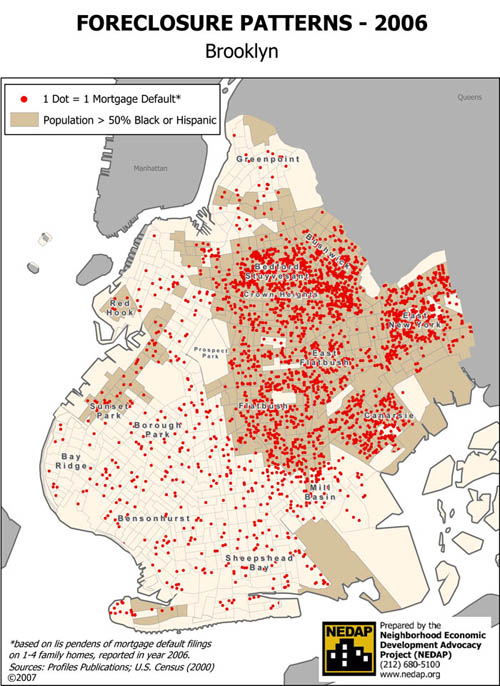
The subprime mortgage mess is making headlines, but what the media barely mentions is that the African community is bearing the brunt of it.

Once again, bankers, brokers, lenders and even regular white working America have profited mightily and are bailed out by the government when their strategy fails. The African community is used, bled dry, and then criminalized and blamed for the problem.

You have to dig to find out that, for instance, more African borrowers making upwards of $100,000 a year were given subprime mortgages than were whites making under $40,000. African communities were targeted for subprime and adjustable rate mortgages as a very lucrative new market for loan sharks.

Cities with large African populations tell the story: Atlanta (map), Cleveland (map), Detroit, Brooklyn (map), to name a few.

Early in this decade the government and the Fed began lowering interest rates. Housing prices skyrocketed and millions of Americans began tapping into their home equity, fueling a “wealth effect,” and massive spending.

The lower rates sparked the speculative housing market and gentrification, as lower income white people could suddenly become homeowners by buying in an African community. Or they could become entrepreneurs by buying up “ugly houses” to flip.

TV channels were spawned by gentrification and a whole economy centered on Lowe’s, Home Depot, Restoration Hardware, Starbucks, art galleries and cute restaurants. Houses of Africans, including the elderly, were taken from under them as white people demanded that code violations be enforced for their benefit.

As housing prices in African neighborhoods skyrocketed, the culture of the community was criminalized and police presence intensified to protect the white “pioneers” from the surrounding impoverished population. African people were dispersed further and further into decaying suburbs, crunched in with other family members or sent to government-sponsored prison housing.

None of this is new, however. It’s the same story that has played out for more than half a millennium.

Since African human beings were first abducted at gunpoint from Africa, turned into a commodity and transported to America as well-insured cargo, stacked on pallets in the holds of ships, the Western world has gotten its economic stimulus from the oppression of others.

More than anything, America sits on the backs of Africans.

Today we talk about oil prices and fluctuations in the stock market, but there were whole centuries when the price of an African was the most important topic at businessmen’s lunches in New York and London. The Wall Street stock exchange sits on the site of New York auction blocks and slave ship docks.

The African cemetery found under a high rise building on Wall Street is the perfect metaphor for this country: America’s wealth resting literally on the bodies of African people.

As Omali Yeshitela proves in his books Omali Yeshitela Speaks and One Africa! One Nation!, Europe was a cold, barren, impoverished and war-like place in the Middle Ages. It was characterized by oppression, plague and feudal serfdom when it set out to rescue itself by ravaging Africa.

Henry the Navigator of Portugal sent ships out to the coast of West Africa around 1420, and by the year 1500 Europe had already extracted 81,000 African people and 700 tons of gold from Africa.

Around the same time Columbus began the process of massive genocide of the Indigenous people of the Americas and the theft of their land and resources.

We are taught ridiculous myths that somehow Europe worked hard, saved its money and thus became the dominant economic and military power in the world. But an honest look at history shows that the development of wealth and power in Europe parallels its assault on Africa and other peoples every step of the way.

In the 1500s the Spanish government monopolized the trade in African human beings, even as the governments of Holland, England and France were waiting in the wings. They would all go to war for a piece of this most valuable commodity, just as oil wars are being fought today.

Independent businessmen also wanted some of this loot, financing their own ships as pirates or “privateers” under the banner of “free trade.” Entrepreneurs like Jean Lafitte raided the state-owned slave ships laden with human cargo and made a fortune selling Africans off the coast of New Orleans at discount rates.

As Yeshitela, again points out, the trade in African people did far more than make southern plantation owners wealthy. The plantations are long gone but the wealth of African enslavement has been compounded in the overall economy of America a million times over.

What part of Europe’s and America’s economy did not get started on the human trade? Banking, insurance, ship building, industry, universities, tourism, railroads, housing, hotels, law firms, the garment industry, retail sales, Wall Street itself were all spawned by African enslavement.

We’re taught that Africans became “free” after the official enslavement ended in 1865 in the U.S. In reality other forms of African exploitation were found to be more lucrative for the Western economy.

In Africa Europe imposed direct colonialism. There was no word for “genocide” when Europe and America were slaughtering millions of African people on the continent as they ripped out diamonds, rubber, ivory, gold, and other precious resources that further consolidated Western wealth and power.

Rarely discussed, but extremely important to America’s wealth, is the system of convict leasing. For more than 70 years thousands of African people were rounded up under Jim Crow laws, kept in work camps and leased out by state governments to plantations, limestone and phosphorus mines, road gangs and logging teams.

The brutal system of convict leasing rebuilt the economy of the southern states following the Civil War. In the late 19th century more than 80 percent of the revenue of Alabama came from convict leasing. I have read that Hitler modeled work camps on the convict leasing system, which was known to be worse than slavery. The white people’s motto was, “One dies, get another.”

European immigrants coming to America were pretty clear that American “opportunities” came to them because of African enslavement and the genocide against the Indigenous people.

Throughout most of the 19th century street gangs made up of white workers in northern cities functioned as a terrorist force against African people who had escaped to the north.

Lynching was the popular pastime of white America for a hundred years. These chilling festivals of violence had the avid participation of the whole white family. Children were dressed up and posed for photographs in front of the lifeless bodies of African people. This public torture and murder of African people was accompanied by music, dancing and food vendors.

White people terrorized Africans who were prospering in independent economic communities. Tulsa, Oklahoma and Rosewood, Florida are only the most famous examples of this. All over the country Africans banded together, buying land and setting up collective economic ventures that were quite successful, but these were destroyed one after another. White people would never allow Africans to become more prosperous than they.

Similarly, the media tell us the reason Africa is poor today is because its leaders are “corrupt.” But every time an African leader rises up, demanding that the resources of his country benefit the people, the leader has been assassinated or overthrown by America or Europe—from Patrice Lumumba to Kwame Nkrumah to Thomas Sankara.

It’s not corruption; it’s the U.S. policy of neocolonialism, which ensures that Africa’s resources stay in the pocket of Western powers. I have read that more than 80 percent of all the mineral resources the U.S. needs to function are in Africa. This is the basis for the U.S. militarization of Africa under AFRICOM.

In this country, after the leaders of the Black Power Movement of the 1960s were assassinated or imprisoned by the government, the U.S. began flooding African communities with drugs: heroin and later crack cocaine. This is well-documented from many sources.

We cannot underestimate the importance of this illegal drug trade to the U.S. economy. Said by the United Nations to be worth more than $500 billion a year, illegal drugs constitute the third largest commodity in the world, behind oil and arms.

Clearly those billions of narco-dollars are not floating around in African communities, but rather buy the cars, mansions and private jets of the Wall Street elite. They also benefit white society as a whole. Since the late 70s drug money has funded real estate, car dealerships, jewelry stores, restaurants and more.

Meanwhile, the African community is left with a government-imposed, penny-ante illegal drug economy that primarily serves to criminalize the entire African population. The imposed drug economy feeds the prison industry, another booming component of the U.S. economy.

More than half of the 2.3 million prisoners in the U.S. today are African, the cornerstone of a $50 billion industry. Called the new gold rush, the prison industry has spawned countless spin-off businesses, including phone companies, clothing, construction, vending machines, instruments of suppression and more.

Most prisons are filled with urban Africans but located in rural white America, where prisons are the third largest industry, behind gambling and pig farming. Many states have a conscious strategy to use prisons as economic stimulus for rural counties, providing white high school graduates high paying jobs as guards.

Some people are predicting that the subprime collapse along with the low dollar and high oil prices could bring about the demise of the U.S. economy.

If so, it’s just the logical conclusion of an obese, parasitic economic system that has been sitting on a shaky foundation of enslavement and genocide for more than 500 years.

Penny Hess is author of Overturning the Culture of Violence and the chair of the African People’s Solidarity Committee which is led by the African People’s Socialist Party. Her analysis is based on the understandings of Omali Yeshitela. She can be reached at info@apscuhuru.org.